
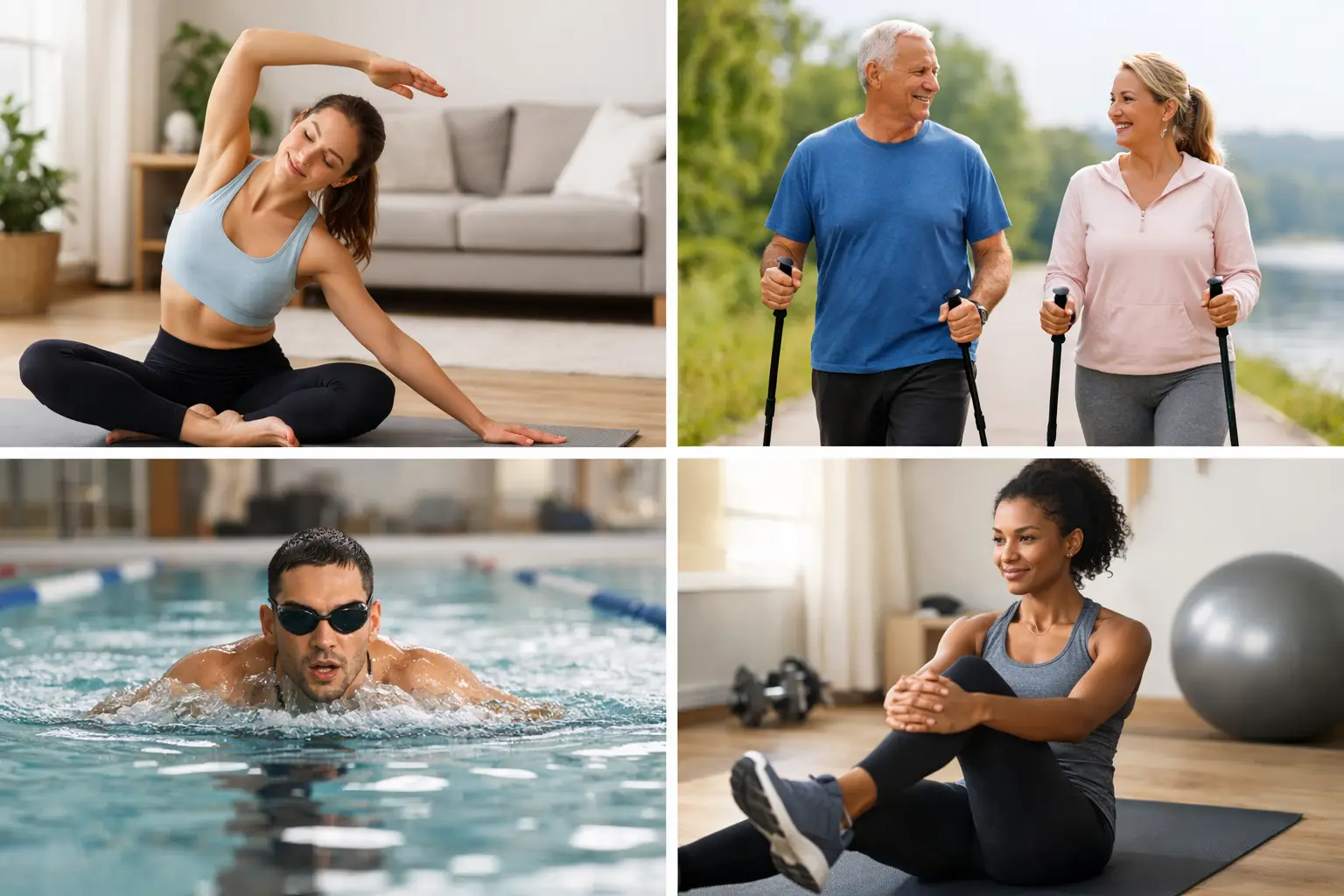
A workout does not need pounding, jumping, or all-out effort to improve your health. The best low impact workouts can raise your heart rate, build strength, support mobility, and help you stay active consistently – often with less stress on the hips, knees, ankles, and back.
That makes them useful for many people: beginners, adults returning after a break, people in larger bodies, those managing joint discomfort, and experienced exercisers who need recovery-friendly training. Low impact is not automatically easy, though. A brisk incline walk or a hard cycling class can be very challenging while still being low impact.
What “low impact” actually means
Low-impact exercise generally means at least one foot stays in contact with the ground or a surface supports much of your body weight. This reduces repeated landing forces compared with activities such as running, box jumps, or jump rope.
It does not mean the workout has no risk or that it is appropriate for every injury. Poor form, too much resistance, or a sudden increase in duration can still lead to pain or overuse problems. The right choice depends on your current fitness level, access to equipment, preferences, and any medical limitations.
Federal physical activity guidelines recommend adults aim for at least 150 minutes of moderate aerobic activity each week, along with muscle-strengthening activities on two or more days. Low-impact workouts can help you meet both goals without requiring a high-impact routine.
10 best low impact workouts to consider
1. Brisk walking
Walking is one of the most practical forms of exercise because it is free, adaptable, and easy to fit into daily life. A relaxed stroll is valuable for movement and stress relief, but a brisk pace that makes breathing noticeably faster provides greater cardiovascular benefit.
To make walks more challenging without running, add hills, use an incline treadmill, increase your pace in short intervals, or carry light trekking poles. Supportive shoes matter, especially if you walk on concrete or have foot discomfort.
2. Stationary or outdoor cycling
Cycling is a strong option for cardio with minimal impact because the bike supports your body weight. It can be especially appealing if running irritates your knees or ankles, although bike fit is important: a seat that is too low may place extra stress on the front of the knee.
A beginner-friendly approach is steady, comfortable cycling for 20 to 30 minutes. For a more vigorous session, alternate one minute of harder pedaling with two minutes of easier effort. If you are new to cycling, increase resistance gradually rather than trying to match an intense class right away.
3. Swimming
Swimming provides a full-body workout while buoyancy reduces stress on weight-bearing joints. Different strokes challenge the body in different ways, and even an easy lap session can build aerobic fitness over time.
The trade-off is access. Pools are not available to everyone, and swimming technique can feel frustrating at first. Start with short sets and rest as needed rather than forcing continuous laps. If shoulder pain develops, consider switching strokes or asking a qualified instructor to check your form.
4. Water aerobics or water walking
For people who do not enjoy lap swimming, water aerobics is a highly effective alternative. Water creates resistance in every direction, while the pool helps support the body. Classes may combine marching, leg movements, arm exercises, and simple cardio patterns.
Water walking is even simpler. Walk forward, backward, and sideways in chest- or waist-deep water, using your arms to create resistance. It can be an approachable starting point for people with arthritis, balance concerns, or significant joint pain, provided a clinician has cleared exercise.
5. Elliptical training
An elliptical machine combines a smooth stepping motion with optional arm handles. It can work the lower body and raise the heart rate without the repeated landing associated with jogging. Adjusting resistance and incline gives you room to progress.
Some people find ellipticals less natural than walking, and handrails can encourage slouching. Stand tall, keep a light grip, and let your legs do the work. If the motion causes numbness, hip pinching, or knee pain, lower the resistance or choose another option.
6. Rowing machine workouts
Rowing is a low-impact, full-body exercise that uses the legs, hips, back, and arms. It can offer a satisfying cardio workout while also building muscular endurance. However, it is more technique-dependent than walking or cycling.
The stroke should begin with the legs, followed by the torso and then the arms. On the return, reverse the order. Many beginners pull mostly with their arms or round their lower back, which can make rowing uncomfortable. A few minutes of instruction can make a meaningful difference.
7. Pilates
Pilates emphasizes controlled movement, core strength, posture, and body awareness. Mat Pilates requires little equipment and can be modified for many fitness levels. It is not always a major cardio workout, but it can complement aerobic training by improving strength and movement control.
For beginners, look for classes labeled foundational or beginner-friendly. Moves should feel challenging but controlled. Sharp pain, especially in the neck or low back, is a signal to stop and adjust the exercise rather than push through.
8. Yoga
Yoga can improve flexibility, balance, and muscular endurance while providing a calming change of pace from more intense exercise. Styles vary widely. Gentle, hatha, and restorative classes are generally slower, while power yoga may be demanding enough to count as moderate exercise for some people.
Yoga is not the best standalone choice if your primary goal is cardiovascular fitness, but it can be valuable for mobility and recovery. Use blocks, straps, or a chair when needed. Flexibility is not a prerequisite for starting.
9. Low-impact strength training
Strength training is often overlooked when people search for joint-friendly workouts, but it is one of the most useful choices for long-term function. Building muscle helps support everyday activities such as climbing stairs, carrying groceries, and getting up from a chair.
Exercises such as sit-to-stands, wall pushups, resistance-band rows, glute bridges, and step-ups can be adapted to many abilities. Start with one or two sets of 8 to 12 controlled repetitions. The last few repetitions should feel challenging while form remains steady.
10. Dance-based low-impact classes
Low-impact dance classes can make cardio feel less like a chore. Many programs offer modifications that replace jumps with steps and allow participants to control intensity. The music and group setting may also help with motivation.
Choose a class that clearly identifies itself as low impact, and give yourself permission to simplify the moves. Coordination improves with practice. The best routine is not the one that looks perfect – it is the one you are comfortable returning to.
How to choose a low-impact workout you will keep doing
Start with a workout that matches your real life, not an idealized plan. If you have a safe walking route, walking may be more sustainable than a gym routine that requires a long commute. If you enjoy water exercise, a pool membership may be worth more than a machine you dislike using.
Then consider your goal. For heart health and calorie-burning activity, walking, cycling, swimming, rowing, and the elliptical are strong choices. For strength and joint support, prioritize resistance training. For flexibility, balance, and stress management, yoga or Pilates may fit best. Many people benefit most from combining two or three types of movement across the week.
Use the talk test to judge intensity. During moderate activity, you should be able to talk in short sentences but not sing comfortably. You do not need to finish every workout exhausted. Consistency at a manageable intensity is usually more useful than an occasional punishing session followed by days of soreness.
A simple weekly low-impact routine
A balanced week could include three 30-minute brisk walks or cycling sessions, two short strength workouts, and one yoga, Pilates, or mobility session. This is only a framework, not a rule. Ten-minute activity breaks count, and you can build toward longer sessions over time.
Increase one variable at a time: duration, frequency, pace, incline, or resistance. A gradual approach is especially important after illness, injury, surgery, or a long period of inactivity. The American College of Sports Medicine also emphasizes that regular physical activity can be adapted to a wide range of abilities.
When to check with a health professional
Talk with a clinician before beginning a new routine if you have chest pain, unexplained shortness of breath, dizziness, a recent injury, uncontrolled blood pressure, or a condition that affects exercise safety. Seek prompt medical care for chest pressure, fainting, or severe pain during activity.
For ordinary muscle fatigue, rest and recovery are part of progress. But joint pain that is sharp, worsening, or still present after exercise deserves attention. A physical therapist, certified trainer, or clinician can help identify modifications that keep you moving safely.
The most helpful workout is the one that leaves you feeling capable, not defeated. Choose one low-impact activity you can do this week, keep the first session modest, and let repeated effort build the confidence and fitness that make an active life easier.
Leave Feedback: Was this article helpful?