
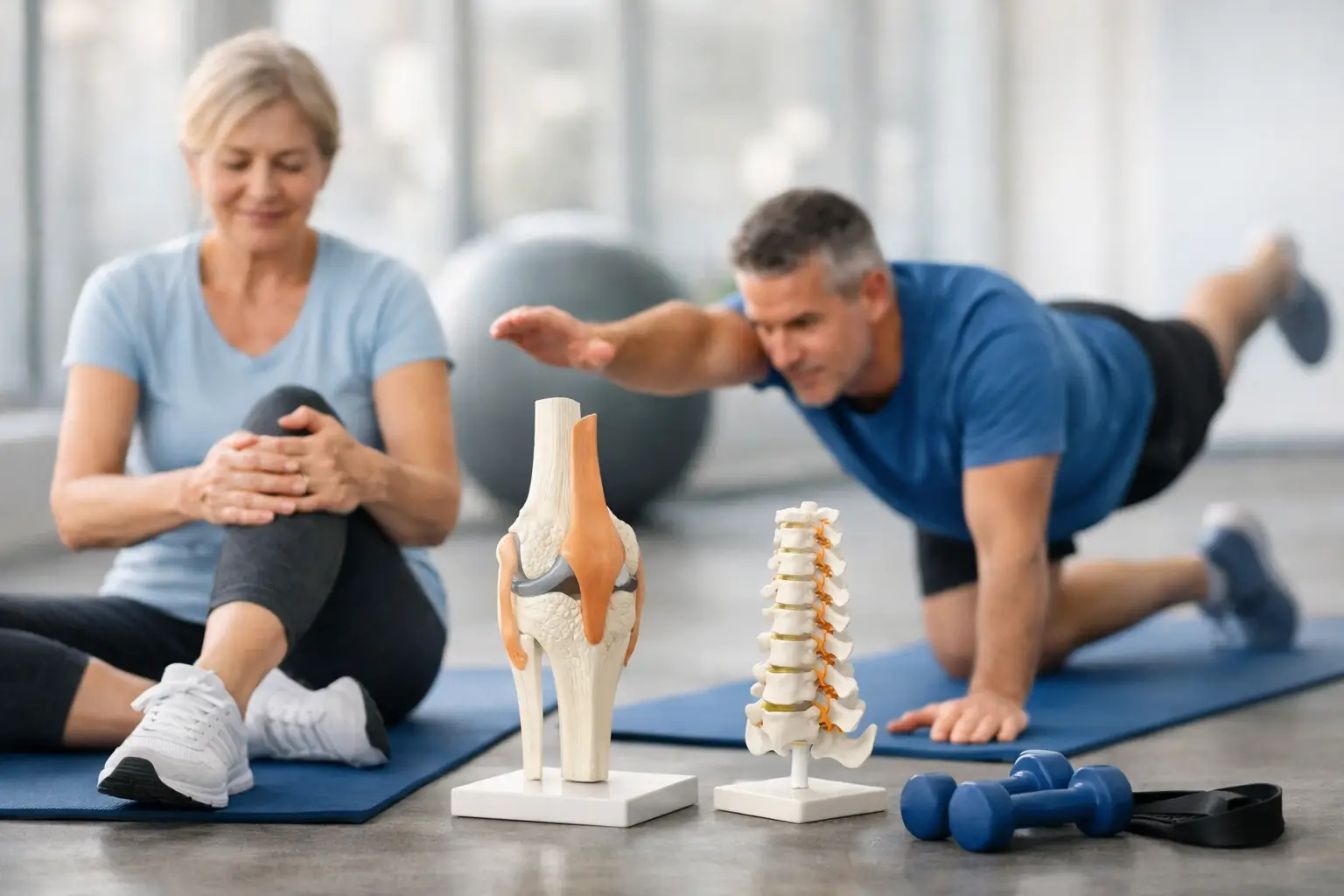
A knee that aches on the stairs, stiffens after sitting, or complains during a walk can make exercise feel like a risky proposition. Yet the best exercises for bad knees are often not no exercise at all. The right mix of strengthening, mobility work, and low-impact cardio can help support the muscles that guide and protect the knee joint.
That does not mean pushing through sharp pain. Knee pain has many possible causes, including osteoarthritis, a past injury, tendon irritation, or problems involving the kneecap. The safest plan depends on the source of the pain, your fitness level, and whether your symptoms are stable. Still, these exercises are commonly used in knee-friendly programs because they build strength with relatively low joint stress.
Why Strengthening Can Help a Painful Knee
The knee relies on the quadriceps at the front of the thigh, hamstrings at the back of the thigh, calves, and hip muscles to absorb force and keep the leg aligned. When those muscles are weak, everyday tasks such as standing from a chair or stepping down from a curb can place more strain directly on the joint.
Research on knee osteoarthritis consistently supports exercise therapy as a first-line approach for improving pain and function. Strength work is not a cure for arthritis or a substitute for medical care after an injury, but regular, appropriately scaled movement can make daily activity more manageable.
A useful rule is to work in a comfortable range of motion. Mild muscle effort or temporary stiffness can be normal. Sharp pain, catching, buckling, substantial swelling, or pain that is clearly worse the next day is a sign to stop and reassess.
10 Best Exercises for Bad Knees
Start with two or three sessions per week, leaving a day between strength sessions when possible. Begin with one set of 8 to 12 controlled repetitions unless otherwise noted. As the movements become easier, add repetitions, another set, or light resistance.
1. Quad Sets
Sit or lie down with your affected leg straight. Tighten the front thigh muscle by gently pressing the back of the knee toward the floor or bed. Hold for 5 to 10 seconds, then relax.
Quad sets are a simple starting point when bending the knee is uncomfortable. They help reconnect you with the quadriceps without requiring weight-bearing movement.
2. Straight-Leg Raises
Lie on your back with one knee bent and the other leg straight. Tighten the thigh of the straight leg, then slowly lift it about 12 inches off the floor. Pause briefly and lower with control.
Keep the knee straight throughout the movement. If your back arches or hip flexors take over, lower the lift height. This exercise can strengthen the quadriceps while keeping knee bending minimal.
3. Seated Knee Extensions
Sit tall in a sturdy chair with both feet on the floor. Slowly straighten one knee until the leg is nearly parallel to the floor, pause, and lower it back down. Avoid forcefully locking the knee.
This is an easy way to build quadriceps strength at home. If it feels comfortable, add a light ankle weight only after you can perform the movement smoothly without increased pain.
4. Sit-to-Stands
Sit near the front of a firm chair with your feet hip-width apart. Lean slightly forward, press through your feet, and stand up without using your hands if you can. Slowly lower yourself back to the chair.
Sit-to-stands train a movement you use every day. Raise the chair height or place a cushion on the seat if deep bending hurts. As strength improves, gradually use a lower seat.
5. Glute Bridges
Lie on your back with your knees bent and feet flat on the floor. Tighten your glutes, press through your heels, and lift your hips until your body forms a gentle line from shoulders to knees. Lower slowly.
Strong glutes help control hip and thigh position during walking, climbing, and squatting. That matters because knee comfort is influenced by how the whole leg moves, not just the knee itself.
6. Side-Lying Leg Raises
Lie on one side with your bottom knee bent slightly and your top leg straight. Keeping your hips stacked, lift the top leg a short distance, then lower it slowly. Do not roll backward to make the movement bigger.
This exercise targets the outer hip muscles, which help keep the knee from collapsing inward during single-leg activities. A small, well-controlled lift is more useful than a high lift with poor form.
7. Standing Calf Raises
Stand near a counter or chair for balance. Rise onto the balls of your feet, pause, and lower your heels slowly. Keep your weight evenly distributed rather than rolling to the outside of your feet.
The calves help absorb force when you walk and climb stairs. If both legs feel easy, progress later to a single-leg version while holding on for support.
8. Low Step-Ups
Use a low, stable step, ideally 4 to 6 inches high at first. Step up with the stronger or more comfortable leg, bring the other foot up, then step down slowly. Keep your knee pointing in the same direction as your toes.
Step-ups prepare the knee for curbs and stairs, but height matters. A step that causes pain or makes the knee cave inward is too challenging right now. Lower the height, slow down, or return to sit-to-stands first.
9. Stationary Cycling
A stationary bike provides low-impact aerobic exercise and repeated, controlled knee motion. Set the seat high enough that your knee has a slight bend at the bottom of the pedal stroke. A seat that is too low can increase knee compression.
Begin with 5 to 10 easy minutes and low resistance. If cycling causes pain at the front of the knee, try raising the seat slightly or reducing resistance. Recumbent bikes can be a comfortable option for people who need more back support or feel unsteady.
10. Water Walking or Swimming
Water buoyancy reduces the amount of body weight the knees must support, making pool exercise useful for people whose pain flares with land-based activity. Water walking, gentle flutter kicking, and swimming can build endurance without pounding.
Choose a stroke and pace that feel good. Breaststroke can irritate some knees because of its whip-kick motion, especially if pain is on the inner side of the knee. Water walking is often the more predictable choice.
How to Build a Knee-Friendly Routine
For many people, a practical starting routine is 10 minutes of easy cycling or water walking, followed by three or four strength exercises. Choose a manageable amount rather than trying to complete all 10 movements in one session. Consistency is more valuable than an exhausting workout that leaves you too sore to move for several days.
Use the 24-hour response as a guide. If discomfort stays mild during exercise and settles back to your usual level by the next day, the session was likely an appropriate dose. If swelling, limping, or pain noticeably increases and remains elevated, reduce the range of motion, repetitions, resistance, or frequency next time.
Walking can also be a good choice for bad knees, but it depends on your symptoms and footwear. Flat, predictable surfaces and shorter walks may be better tolerated than hills, uneven trails, or long outings. Supportive shoes will not solve every knee problem, but worn-out footwear can make an already irritated joint less comfortable.
When to Get Medical Guidance First
See a clinician or physical therapist before starting a new routine if knee pain began after a fall or twist, the joint looks deformed, you cannot bear weight, or the knee repeatedly gives way. Prompt assessment is also wise for major swelling, redness or warmth with fever, a locked knee, or calf swelling.
If pain has been lingering for weeks, a physical therapist can identify whether your program needs more hip strength, better movement mechanics, different exercise choices, or a slower progression. That individualized guidance can be especially helpful after surgery or with conditions such as rheumatoid arthritis.
Your knees do not need punishing workouts to become more capable. Begin with movements you can control, make small progressions, and let comfort and function, not soreness, guide the pace.
Leave Feedback: Was this article helpful?